
Authors
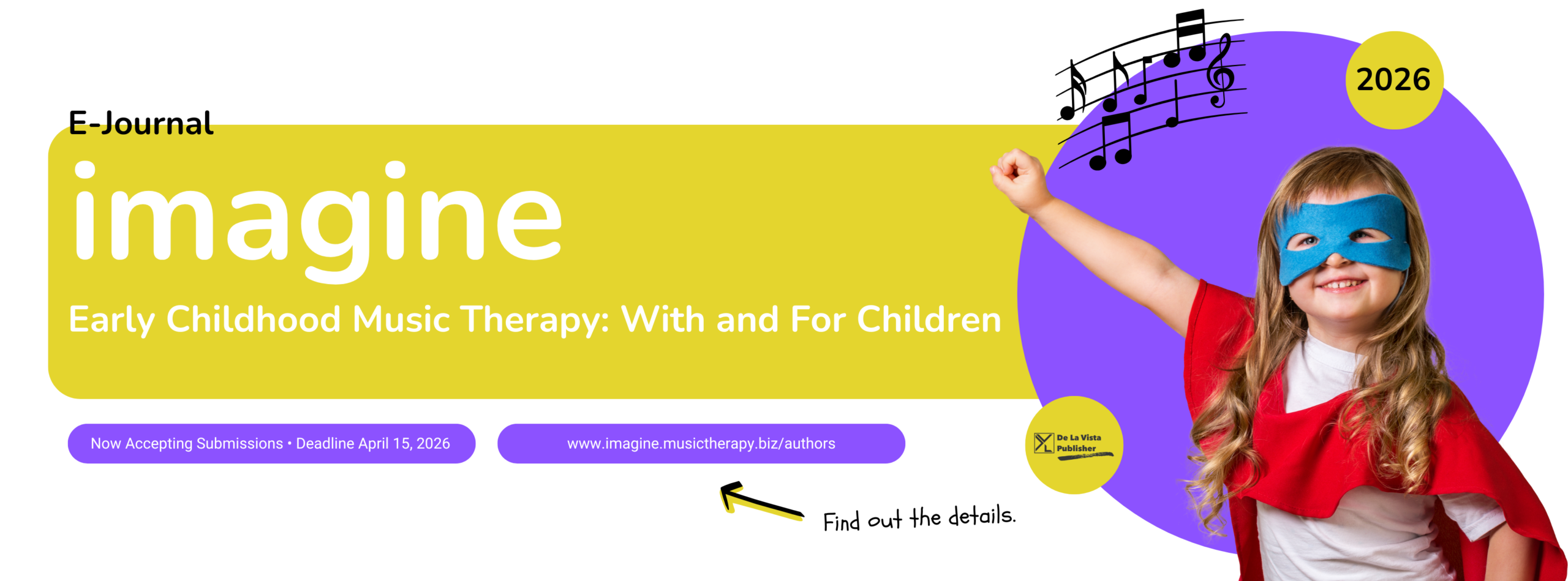
Accepting submissions until: April 15, 2026
Day(s)
:
Hour(s)
:
Minute(s)
:
Second(s)
imagine
imagine is an interactive, multimedia e-journal that serves as a leading resource for early childhood music therapy (ages birth to five). We publish work grounded in evidence-based practice, bringing together current research and practical experience. Our content supports practitioners, families, and interdisciplinary professionals through clear and accessible writing that reflects the needs of young children and those who work with them.
2026 Call for Submission
Theme: “Early Chidlhood Music Therapy–With and For Children”
Calling all innovators! Share your practical ideas for empowering, informing, and including young children in music therapy sessions.
Submissions may address one or more of the following themes:
1️⃣ Listening to Youngest Voices
Creative ways children’s choices, preferences, and responses shape the design and delivery of music therapy—even among preverbal or minimally verbal clients.
2️⃣ Explaining Music Therapy to Children
Strategies, media, and child-friendly tools that help young children understand what music therapy is, what happens in sessions, and how they can take part.
3️⃣ Child-Led Sessions
Insights into child-directed sessions, spontaneous music-making, play-based co-creation, and shared musical leadership.
4️⃣ Voice and Agency
Developmentally appropriate approaches that support early self-expression, decision-making, and autonomy in music therapy settings.
5️⃣ Neurodiversity and Inclusion
Perspectives on empowering neurodivergent children to shape their own therapeutic experiences, communication pathways, and sensory environments.
6️⃣ Children as Advocates
Examples of how young children share their music therapy experiences in public or community settings—through performances, storytelling, drawings, or audio/video.
7️⃣ Practice-Based Evidence
Case examples, outcomes research, reflective practice, and emerging findings showcasing the impact of child-centered approaches on development, communication, and family dynamics.
8️⃣ Playful Innovations
Creative tools—songs, storybooks, games, visual supports, apps, and digital interactives—that enhance engagement, participation, and joy in therapy.
9️⃣ Collaborative Goal-Setting
Child- and family-friendly approaches that invite young children into shared goal-setting using visuals, music-based choices, routines, or symbol-supported communication.
🔟 Global & Cultural Perspectives
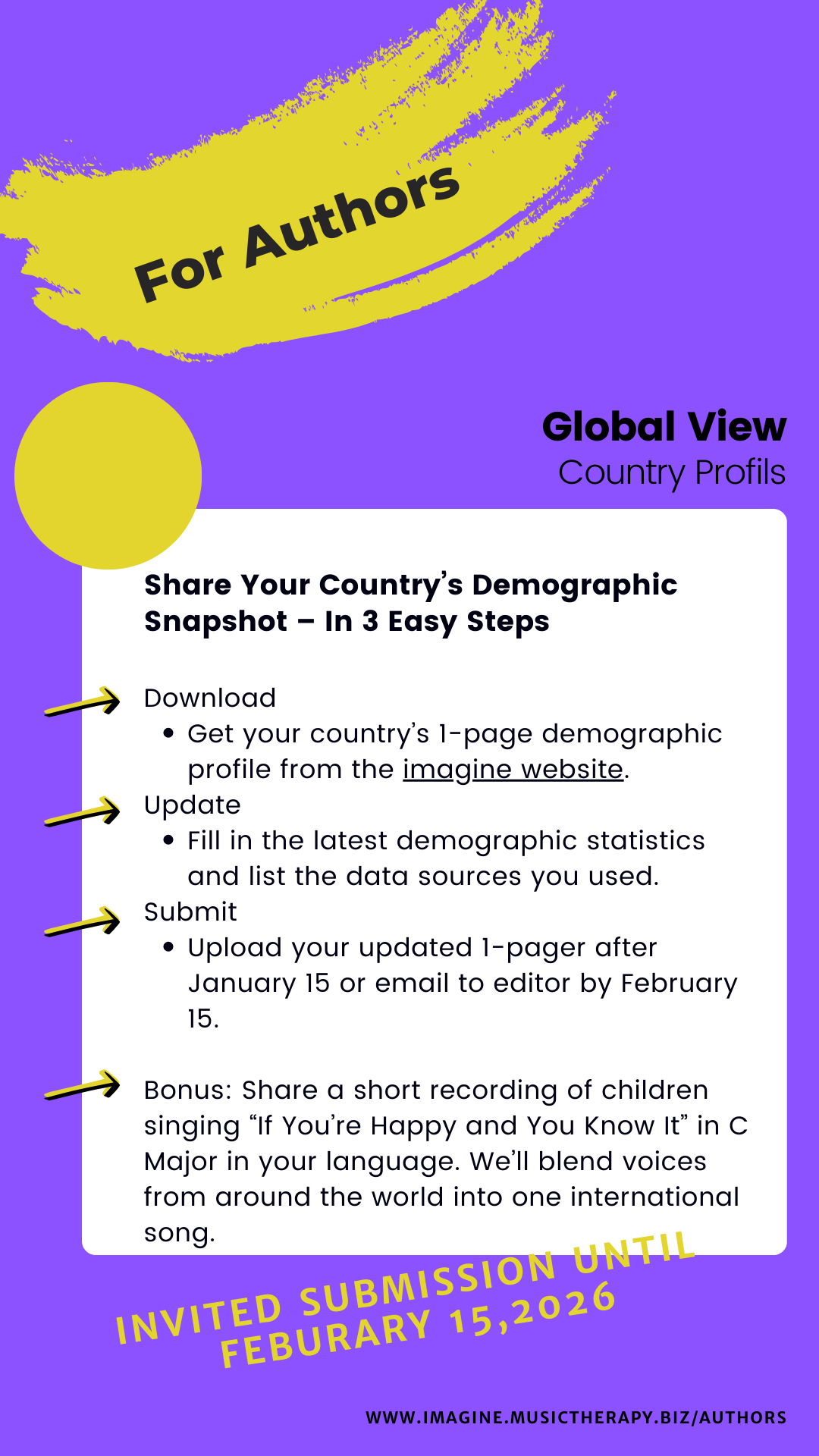
International or culturally grounded approaches that honor young children’s identities, communication styles, and participation in music therapy around the world.
✏️ Potential Contributors
We welcome submissions from:
Music therapists, early childhood educators, play therapists, child development researchers, speech-language pathologists, parents/caregivers, advocates, and children (with adult support).
🗓️ Submission Deadline: April 15, 2026
📍 Submission Portal: www.imagine.musictherapy.biz/authors
🎯 Let us know which topic you choose to avoid duplication!
We encourage multimedia and collaborative formats, including video, audio, interviews, child art, and co-authored pieces between therapists and families.
Style
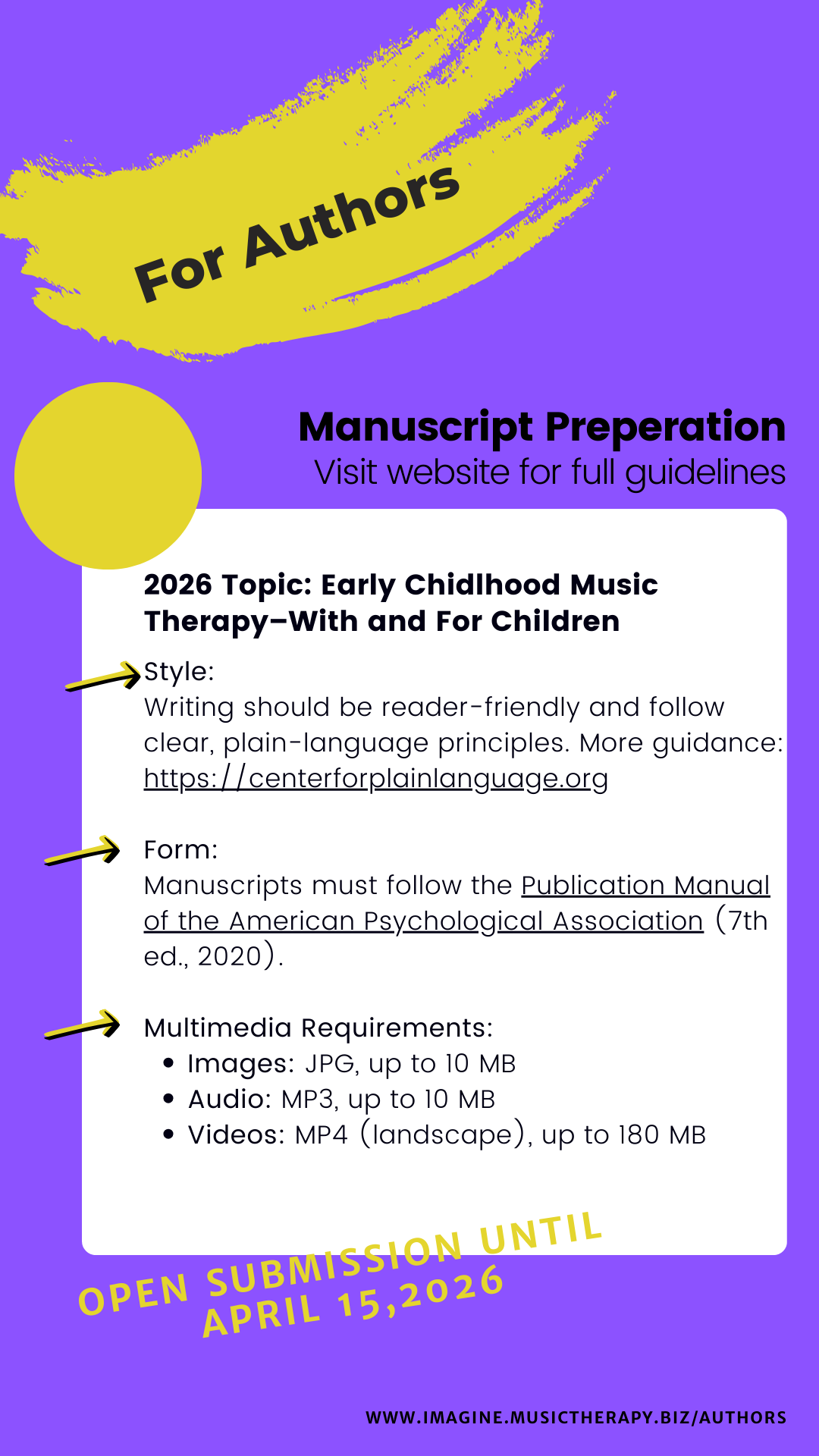
Writing should be clear, accessible, and reader friendly, following plain-language principles (see http://centerforplainlanguage.org). Manuscripts should be written for early childhood music therapy practitioners and related professionals, using a concise and engaging style that supports practical application.
Language referring to individuals with disabilities must reflect current, respectful terminology consistent with APA’s guidance. Authors should use person-first or identity-affirming language as preferred by the individual or community being described, and ensure all descriptions uphold ethical, strengths-based, and non-stigmatizing practices.
Form
Manuscripts need to be prepared in accordance with the Publication Manual of the American Psychological Association, Seventh Edition (2020) or the APA Formatting and Style Guide (7th Edition) at the Purdue Online Writing Lab and should range between 250-2000 words (including references, tables and figures). All submissions must include title, name(s) of author(s), professional credentials, institutional affiliation, three-sentence bio with photo for each author, em
Manuscripts should follow APA Style, 7th edition (Publication Manual, 2020, or Purdue OWL). Submissions typically range from 250–2,000 words, including references, tables, and figures.
Each submission must include:
-
Title
-
Author name(s) and credentials
-
Institutional affiliation
-
Email address
-
A three-sentence author bio and photo for each author
-
A short reference list or recommended resources, with DOIs when available
Manuscripts with significant APA formatting issues will be returned for correction before editorial review.
Please submit your manuscript as a .docx file through the online submission portal. Authors must verify that the manuscript is original, unpublished, and not under review elsewhere.
Additional APA resources:
AI Use Policy
imagine supports the careful and ethical use of artificial intelligence (AI) in the writing process. AI may be used for idea generation, summarizing research, translation, and improving clarity, but it does not replace the author’s expertise or judgment.
Transparency
If you use AI at any stage—drafting, editing, translating, or organizing content—please acknowledge this in the methods or acknowledgments section.
Accuracy and Verification
AI-generated text can include errors. Authors are responsible for checking all information, confirming citations and quotations, and ensuring every reference is real and correctly attributed.
Attribution
AI tools should not be cited as sources. When AI assists with identifying or summarizing literature, cite the original works only.
Authorship
AI cannot be listed as an author. A human author must be accountable for the full manuscript.
Ethics and Privacy
Do not enter confidential or identifying information about children, families, or institutions into AI tools. All use of AI must follow professional ethics standards and privacy guidelines.
AI can support your writing, but the final submission must reflect your own thinking, interpretation, and decisions.
Language and International Submissions
We welcome submissions from authors worldwide. All manuscripts must be submitted in English. Authors who are not fluent English writers are encouraged to use language-editing support—this may include review by a fluent English speaker, a professional editing service, or careful use of AI language tools, provided that all revisions are checked for accuracy and clarity.
Translation and manuscript preperation support remain the responsibility of the author and are not provided by imagine.
Multimedia Guidelines
imagine welcomes the inclusion of photos, audio, and video that enhance understanding of the manuscript’s content. All media must comply with professional Codes of Ethics and portray individuals in a respectful and developmentally appropriate manner.
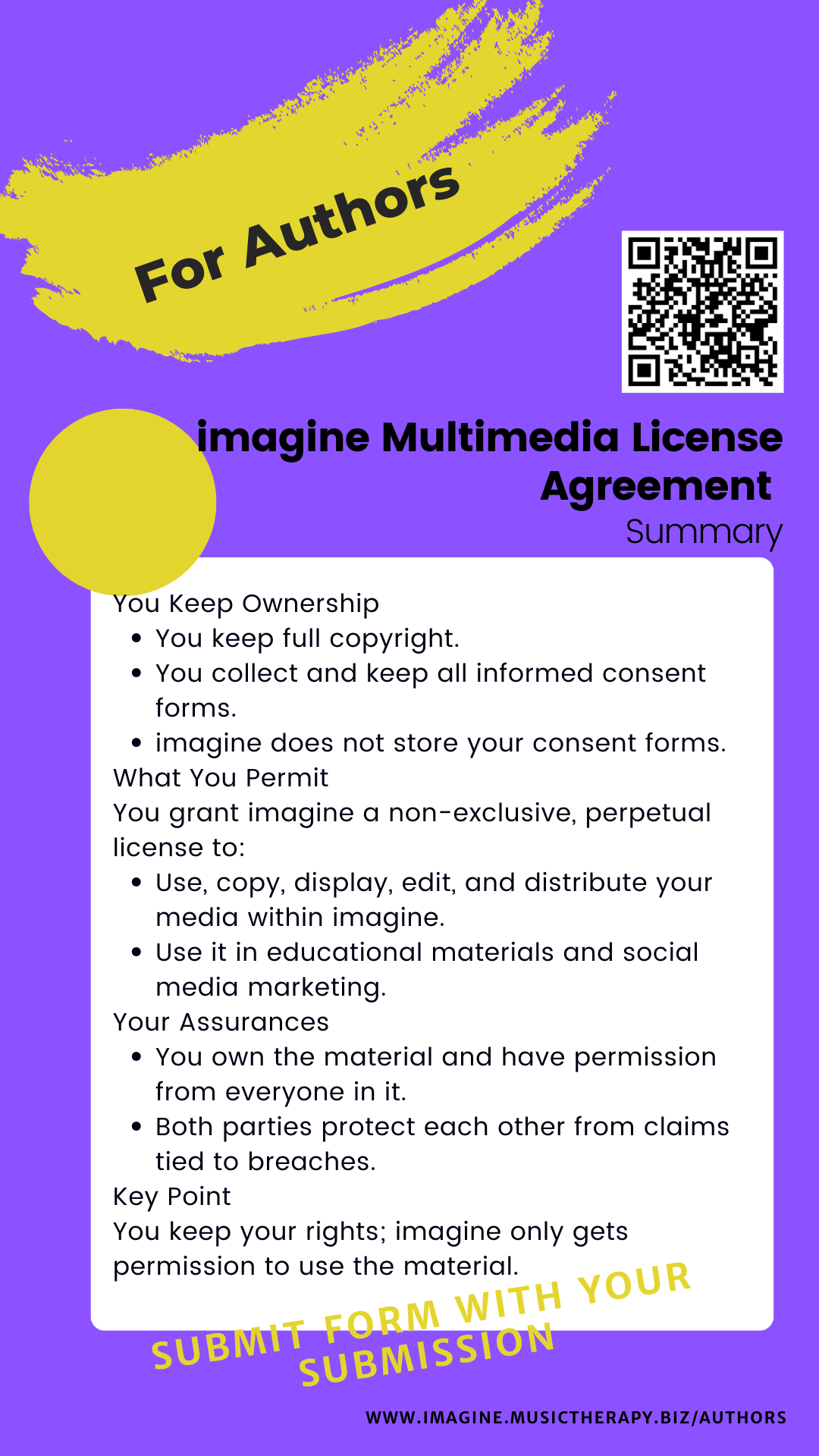
Authors are solely responsible for securing all permissions and releases for any media included in their submission and must sign the imagine Multimedia License Agreement.
Accepted media formats include:
-
Images: JPG, up to 10 MB
-
Audio: MP3, up to 10 MB
-
Podcasts: MP3, up to 100 MB (maximum length: 10 minutes)
-
Video: MP4, landscape orientation, up to 180 MB
Please indicate placement within the manuscript using brackets (e.g., [INSERT PHOTO ABOUT HERE]).
AI and Multimedia Content
AI-generated or AI-enhanced images, audio, or video must be clearly identified in the manuscript. Authors may not upload AI media that depict real individuals without consent or that misrepresent actual clients or therapy interactions. Do not enter confidential or identifiable information into AI tools. All AI-generated media must follow the same ethical and privacy standards as other content.
Review Process
Once your submission is received, you will receive an electronic acknowledgment. After the April 15 submission deadline, the editorial team will review all manuscripts and provide authors with editorial feedback or a notice of rejection within a few weeks.
Manuscripts are reviewed and edited for accuracy, clarity, length, spelling, and style. Authors will then have the opportunity to:
a) revise the manuscript based on editorial feedback, and
b) review and proofread a preliminary layout (PDF) of the article before publication.
Authors are expected to respond within the timelines provided in order to meet publication deadlines. The editorial team reserves the right to reject manuscripts—including invited pieces—if they do not comply with submission guidelines, required revisions, or the intent of the special issue.
Please note that authors are not financially compensated. imagine offers international visibility and a broad, interdisciplinary readership through its interactive e-journal format.
Author Rights and Reprint Permissions
Upon publication, authors retain full copyright ownership of their articles. Authors may distribute, archive, or seek reprint publication of their work without restriction. imagine grants authors a nonexclusive right to reuse their published material in any subsequent work of their own.
Any reprinted, redistributed, or republished version of the article must include the following acknowledgment:
“Reprinted from the [insert year] issue of imagine, the early childhood music therapy interactive e-journal published by de la vista publisher.”
Authors are responsible for ensuring that this acknowledgment appears in all subsequent uses of the work.
Disclaimer
The views, opinions, and information presented in this publication are solely those of the individual authors and do not necessarily reflect the positions of the publisher, editor-in-chief, or editorial team. The publisher and editorial personnel make no representations or warranties regarding the accuracy, completeness, or applicability of the content.
To the fullest extent permitted by law, the publisher, editor, and editorial team disclaim any and all liability for any loss, damage, or adverse outcomes arising directly or indirectly from the use, application, or interpretation of the materials contained in this publication. Users of this publication assume full responsibility for their reliance on its contents.

Be Assured, We Care About Your Work.
Editorial Team
Editor
Petra Kern, PhD, MT-BC, MTA, DMtG
Assistant Editor
Erin Shina, Music Therapist

Assistant Editor
Alex Ruffner, MS, MT-BC